Angle Bisector
An angle bisector is a line or ray that divides an angle into two equal angles. Every point on the bisector is the same perpendicular distance from the two arms of the angle 1.
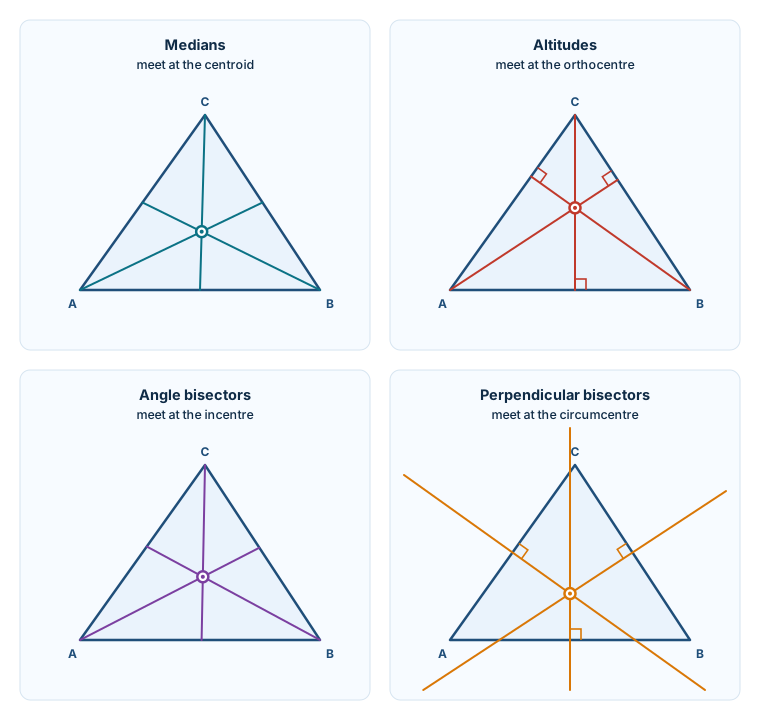
The three angle bisectors (purple) meet at the incentre 2.
The Incentre and Incircle
In a triangle, the bisectors of the three interior angles are concurrent at a point called the incentre 3. Because the incentre is equidistant from all three sides, it is the centre of the incircle — the largest circle that fits inside the triangle and is tangent to each side 3.
Angle Bisector Theorem
The bisector of an angle of a triangle divides the opposite side in the same ratio as the two adjacent sides. If bisects angle and meets at , then 3.
Construction
Use the standard IGCSE straight-edge-and-compasses method 4: with the vertex as centre, draw an arc cutting both arms; from the two crossing points draw equal arcs that intersect; then join the vertex to that intersection 1.
Related
- Triangle - The shape whose angle bisector this is.
- Median - Segment to the midpoint of the opposite side.
- Altitude - Perpendicular from a vertex to the opposite side.
- Perpendicular Bisector - Line through a side’s midpoint at right angles.
- Mathematics - Cambridge IGCSE area this concept belongs to.
Footnotes
-
Math Open Reference - Bisecting an Angle with Compass and Straightedge - Step-by-step construction of an angle bisector and the equal-distance property of points on it. ↩ ↩2
-
Diagram drawn for this bundle, showing the three medians meeting at the centroid, the three altitudes meeting at the orthocentre, the three angle bisectors meeting at the incentre, and the three perpendicular bisectors meeting at the circumcentre. ↩
-
Math Open Reference - The Incenter of a Triangle - The incentre as the meeting point of the three angle bisectors, equidistant from the sides and the centre of the incircle, and the angle bisector theorem. ↩ ↩2 ↩3
-
Cambridge IGCSE Mathematics (0580) Syllabus - Official curriculum framework covering geometrical terms and vocabulary, angle properties, constructions with straight edge and compasses, loci, and mensuration of area and perimeter. ↩