Parallelogram
A parallelogram is a quadrilateral in which both pairs of opposite sides are parallel. As a result, opposite sides are equal in length, opposite angles are equal, and consecutive (adjacent) angles are supplementary — they add to 1.
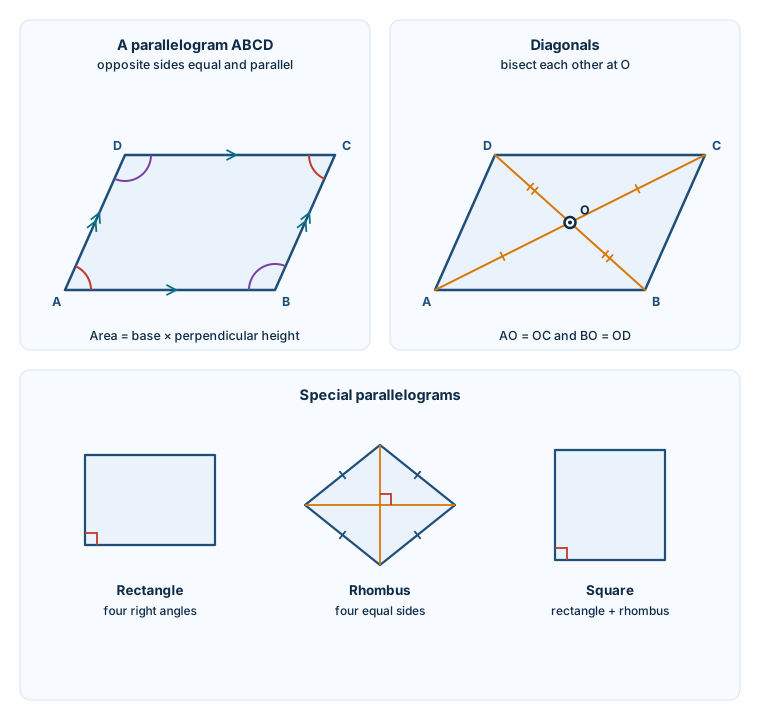
Arrows mark the parallel pairs, matching arcs mark equal angles, and tick marks show the diagonals bisecting each other 2.
Characterizations
A quadrilateral is a parallelogram if any one of these equivalent conditions is true 1:
- both pairs of opposite sides are parallel (the definition);
- both pairs of opposite sides are equal;
- both pairs of opposite angles are equal;
- the diagonals bisect each other;
- one pair of opposite sides is both equal and parallel.
Each condition forces the others, so a single test is enough to prove that a shape is a parallelogram.
Diagonals
The diagonals of a parallelogram bisect each other: they cross at their common midpoint , so and . They are not generally equal in length, and they are not generally perpendicular 1.
Special Parallelograms
- Rectangle — a parallelogram with a right angle, so all four angles are ; its diagonals are equal in length 3.
- Rhombus — a parallelogram with four equal sides; its diagonals are perpendicular and bisect its angles 4.
- Square — a parallelogram that is both a rectangle and a rhombus.
Area and Perimeter
For base , slant side and perpendicular height : (using the perpendicular height, not the slant side) and 5.
Related
- Rectangle - A parallelogram with four right angles.
- Rhombus - A parallelogram with all four sides equal.
- Square - A parallelogram that is both a rectangle and a rhombus.
- Triangle - Three-sided polygon; two congruent triangles form a parallelogram.
- Mathematics - Cambridge IGCSE area this concept belongs to.
Footnotes
-
Math Open Reference - Parallelogram - Definition of a parallelogram, the conditions that prove a quadrilateral is a parallelogram, opposite sides and angles being equal, consecutive angles supplementary, and the diagonals bisecting each other. ↩ ↩2 ↩3
-
Diagram drawn for this bundle, showing parallel-side arrows and equal-angle arcs on a parallelogram, the diagonals bisecting each other at O, and the special cases rectangle, rhombus and square. ↩
-
Math Open Reference - Rectangle - A parallelogram with all interior angles equal to 90 degrees. ↩
-
Math Open Reference - Rhombus - A quadrilateral with all four sides equal; a rhombus is a parallelogram whose diagonals are perpendicular. ↩
-
Cambridge IGCSE Mathematics (0580) Syllabus - Official curriculum framework covering geometrical terms and vocabulary of quadrilaterals, angle properties, and mensuration of perimeter and area. ↩