Ribosome
A ribosome is a tiny organelle in the cytoplasm that is the site of protein synthesis 1. Ribosomes are found in plant, animal and bacterial cells, so all three cell types can make proteins 1.
A ribosome is not surrounded by a membrane; it is a small granule, usually too small to see clearly with a light microscope 2.
Making a Protein
- The gene for the protein stays in the nucleus.
- A copy called messenger RNA (mRNA) is made from the gene and moves to a ribosome in the cytoplasm.
- The ribosome assembles amino acids into a protein chain in the order the mRNA specifies 1.
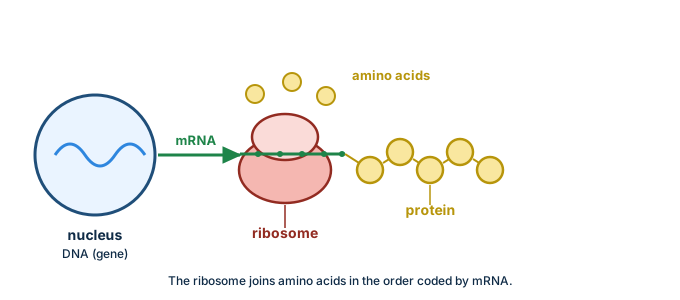
The ribosome reads mRNA and joins amino acids into a protein 3.
Why It Matters
Proteins include enzymes, membrane carriers and receptors, so ribosomes build the molecules that control almost every cell function 1.
Related
- Nucleus - Holds the DNA with the gene for the protein.
- Cytoplasm - Where ribosomes are found.
- DNA - Stores the genetic code copied into mRNA.
- Cell - Structural unit containing ribosomes.
- Cell Membrane - Contains protein carriers and receptors.
- Biology - Cambridge IGCSE life-science area.
Footnotes
-
Cambridge IGCSE Biology 0610 syllabus for examination in 2026, 2027 and 2028 - Ribosomes as a cell structure in plant, animal and bacterial cells and their functions (2.1.1, 2.1.2, 2.1.4); DNA controls cell function by controlling protein production (17.1.7); protein synthesis where mRNA passes through ribosomes and the ribosome assembles amino acids into protein (17.1.8). ↩ ↩2 ↩3 ↩4
-
OpenStax Biology 2e - Eukaryotic Cells - Ribosomes as non-membrane-bound organelles that carry out protein synthesis. ↩
-
Diagram drawn for this bundle: mRNA carries a copy of a gene from the nucleus to a ribosome, which joins amino acids into a protein. ↩