Active Transport
Active transport is the movement of particles through a cell membrane from a region of lower concentration to a region of higher concentration — that is, against a concentration gradient — using energy from respiration 1.
Protein carriers in the membrane move the molecules or ions across it 1. Because the cell must spend energy, the process works even when the concentration on the outside is already lower than on the inside, so diffusion alone could never supply the cell. The energy is supplied as ATP from respiration, which is why the process is sensitive to anything that interferes with the cell’s metabolism, including a lack of oxygen or metabolic poisons 2.
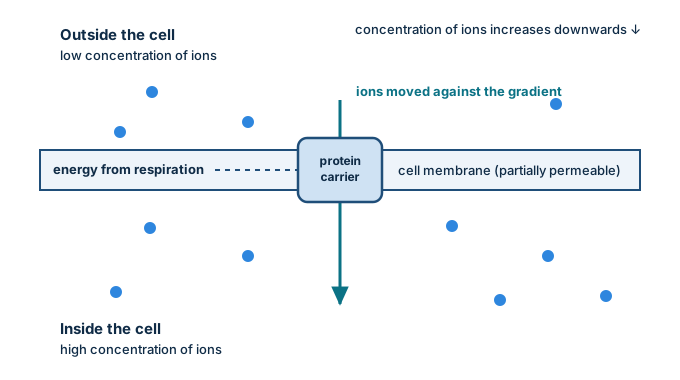
Ions are moved against the gradient into the cell, using energy released by respiration 3.
Compared with Diffusion and Osmosis
| Feature | Diffusion | Osmosis | Active transport |
|---|---|---|---|
| Particles moved | Any particle | Water only | Molecules or ions |
| Direction | Higher to lower concentration | Higher to lower water potential | Lower to higher concentration |
| Energy from the cell | None | None | Released by respiration |
| Membrane protein needed | Not needed | Not needed | Protein carrier required |
Importance
The syllabus example is ion uptake by root hair cells: soil water is more dilute than the cell contents, so mineral ions must be moved in against the gradient 1. Actively absorbing ions, sugars and other solutes lets a cell keep an internal composition different from its surroundings, and cells that do a lot of it — such as root hairs — contain many mitochondria to release the energy 2.
Related
- Diffusion - Passive transport down a concentration gradient.
- Osmosis - Passive transport of water only.
- Partially Permeable Membrane - Barrier property that restricts which particles can cross.
- Cell Membrane - Partially permeable barrier holding the protein carriers.
- Respiration - Releases the energy that active transport uses.
- Mitochondrion - Organelle supplying that energy.
- Root Hair Cell - Absorbs mineral ions by active transport.
- Biology - Cambridge IGCSE life-science area.
Footnotes
-
Cambridge IGCSE Biology 0610 syllabus for examination in 2026, 2027 and 2028 - Active transport as movement against a concentration gradient using energy from respiration (3.3.1), importance including ion uptake by root hairs (3.3.2), protein carriers moving molecules or ions (3.3.3). ↩ ↩2 ↩3
-
OpenStax Biology 2e - Active Transport - ATP as the energy source for transport against an electrochemical gradient, carrier proteins and pumps, and the sensitivity of active transport to metabolic poisons. ↩ ↩2
-
Diagram drawn for this bundle, showing ions moved against their concentration gradient through a protein carrier in the cell membrane, with energy released by respiration. ↩