Osmosis
Osmosis is the net movement of water molecules from a region of higher water potential (a dilute solution) to a region of lower water potential (a concentrated solution), through a partially permeable membrane 1.
Osmosis is a special case of diffusion: because the membrane holds the solute back, only water crosses 2. Water enters and leaves cells through the cell membrane 1.
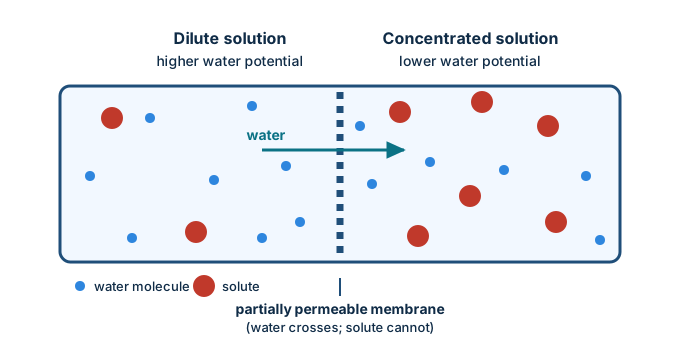
Water moves from the dilute to the concentrated solution until water potentials balance 3.
Osmosis and Animal Cells
An animal cell has no cell wall. In a dilute solution water enters, so it swells and may burst; in a concentrated solution water leaves, so it shrinks; at the same water potential it is unchanged 1.
Osmosis and Plant Cells
A plant cell has a cell wall. In a dilute solution water enters the vacuole and pushes outwards, making it turgid, which supports the plant. In a concentrated solution water leaves: the cell becomes flaccid, then plasmolysed as the cell membrane pulls away from the wall, and it wilts 1.
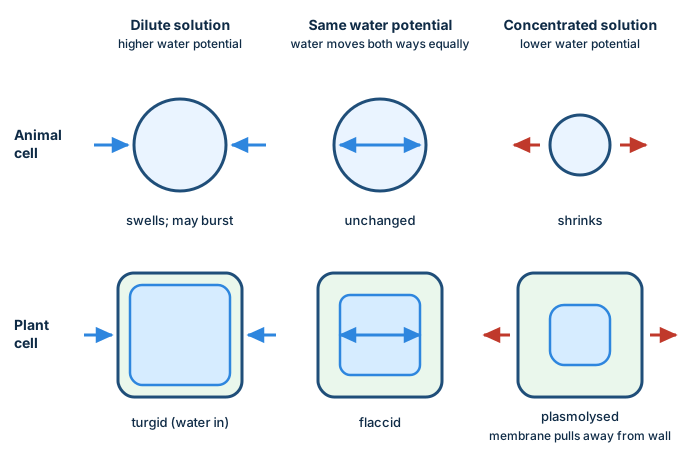
Animal cells swell or shrink; plant cells become turgid, flaccid or plasmolysed 4.
Importance
Water enters root hair cells by osmosis and turgor pressure supports plants; water is also the solvent for digestion, transport and excretion 1.
Related
- Water Potential - The difference that drives osmosis.
- Partially Permeable Membrane - Barrier that lets water through but holds solute back.
- Diffusion - Diffusion of water only.
- Active Transport - Moves solutes against the gradient.
- Cell Membrane - Barrier across which water moves.
- Cell Wall - Rigid layer resisting turgor pressure.
- Small Vacuole - Water store that keeps the cell turgid.
- Root Hair Cell - Absorbs soil water by osmosis.
- Biology - Cambridge IGCSE life-science area.
Footnotes
-
Cambridge IGCSE Biology 0610 syllabus for examination in 2026, 2027 and 2028 - Osmosis and water potential (3.2.7), water diffusing through partially permeable membranes (3.2.2), water moving into and out of cells (3.2.3), effects of solutions on plant tissues: turgid, turgor pressure, plasmolysis, flaccid (3.2.8), importance of water potential and osmosis in the uptake and loss of water (3.2.9), plants supported by water pressure on the cell wall (3.2.6). ↩ ↩2 ↩3 ↩4 ↩5
-
OpenStax Biology 2e - Passive Transport - Osmosis as water movement along its concentration gradient through a semipermeable membrane, tonicity, turgor pressure, plasmolysis and wilting. ↩
-
Diagram drawn for this bundle, showing two solutions of different water potential separated by a partially permeable membrane. ↩
-
Diagram drawn for this bundle, comparing animal and plant cells in dilute, equal and concentrated solutions. ↩