Plasmolysed
A plant cell is plasmolysed when it has lost so much water that the protoplast — the cell membrane and cytoplasm — shrinks and pulls away from the cell wall. The process is called plasmolysis 1.
It follows severe water loss by osmosis in a concentrated solution. First the cell goes flaccid; then, as more water leaves the shrinking vacuole, the membrane separates from the wall 2. A plasmolysed plant wilts and, if the condition continues, the cell may die 1.
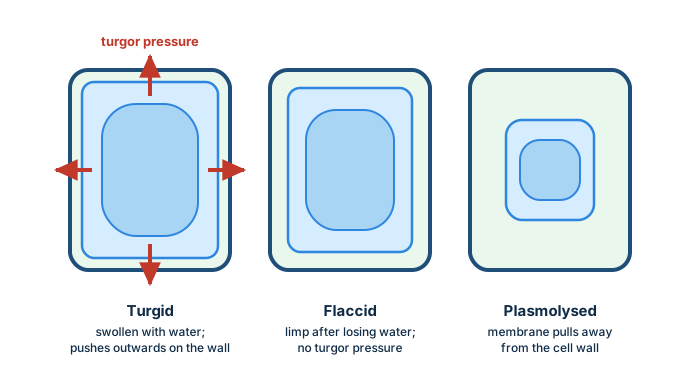
Plasmolysed (right): the membrane has pulled away from the cell wall 3.
Related
- Turgid - The opposite, well-watered state.
- Turgor Pressure - The pressure that has been lost.
- Flaccid - The earlier stage of water loss.
- Osmosis - The water movement that causes it.
- Cell Membrane - The membrane that pulls away.
- Water Potential - Why water leaves.
- Biology - Cambridge IGCSE life-science area.
Footnotes
-
Cambridge IGCSE Biology 0610 syllabus for examination in 2026, 2027 and 2028 - The terms turgid, turgor pressure, plasmolysis and flaccid (3.2.8), and plants supported by water pressure pressing outwards on the cell wall (3.2.6). ↩ ↩2
-
OpenStax Biology 2e - Passive Transport - Turgor pressure in plant cells, tonicity, plasmolysis and wilting. ↩
-
Diagram drawn for this bundle, comparing turgid, flaccid and plasmolysed plant cells. ↩