Water Potential
Water potential is a measure of the tendency of water molecules to move from one region to another. Pure water has the highest water potential; dissolving a solute lowers it, so a dilute solution has a higher water potential than a concentrated solution 1.
Water moves by osmosis from higher to lower water potential, through a partially permeable membrane 1. The membrane holds the solute back, so only water crosses 2.
At IGCSE it is compared qualitatively as higher or lower.
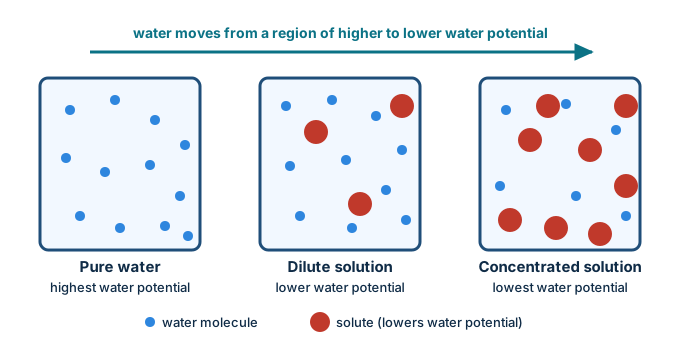
The more solute a solution contains, the lower its water potential 3.
In Cells
The cytoplasm contains solutes, so it has a lower water potential than pure water. A cell in pure water gains water and may burst (animal) or become turgid (plant); in a concentrated solution it loses water, and a plant cell becomes plasmolysed 1.
Water potential explains water uptake by root hair cells and the turgor pressure that supports plants 1.
Related
- Osmosis - The process driven by a water-potential difference.
- Partially Permeable Membrane - The barrier water crosses.
- Cell Membrane - The cell’s partially permeable membrane.
- Root Hair Cell - Absorbs soil water down the water-potential gradient.
- Cell Wall - Resists the turgor pressure from water uptake.
- Biology - Cambridge IGCSE life-science area.
Footnotes
-
Cambridge IGCSE Biology 0610 syllabus for examination in 2026, 2027 and 2028 - Osmosis from higher to lower water potential through a partially permeable membrane (3.2.7), turgid, turgor pressure, plasmolysis and flaccid (3.2.8), the importance of water potential (3.2.9), and plant support (3.2.6). ↩ ↩2 ↩3 ↩4
-
OpenStax Biology 2e - Passive Transport - Selectively permeable membranes, osmosis along the water gradient, and tonicity. ↩
-
Diagram drawn for this bundle: water potential falls from pure water to dilute to concentrated solution. ↩