Turgid
A plant cell is turgid when it is swollen with water, so that the water inside pushes outwards on the cell wall 1.
Water enters the cell by osmosis when the solution outside has a higher water potential than the cell contents, and it fills the large vacuole. The outward push is turgor pressure; the strong cellulose wall resists it, so the cell does not burst 1.
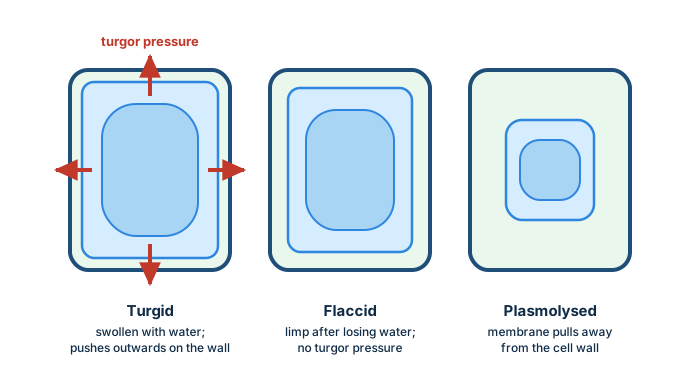
Turgid (left): water in the vacuole presses outwards on the wall 2.
Importance
Turgid cells keep soft plant tissues firm: leaves and young stems stand upright because the cells press on their walls and on each other 1. A cell that loses water becomes flaccid, and one that loses more becomes plasmolysed.
Related
- Turgor Pressure - The outward pressure inside a turgid cell.
- Flaccid - The limp state after water loss.
- Plasmolysed - The state after severe water loss.
- Osmosis - How water enters the cell.
- Water Potential - Why the water enters.
- Cell Wall - The wall that resists the pressure.
- Biology - Cambridge IGCSE life-science area.
Footnotes
-
Cambridge IGCSE Biology 0610 syllabus for examination in 2026, 2027 and 2028 - The terms turgid, turgor pressure, plasmolysis and flaccid (3.2.8), and plants supported by water pressure pressing outwards on the cell wall (3.2.6). ↩ ↩2 ↩3
-
Diagram drawn for this bundle, comparing turgid, flaccid and plasmolysed plant cells. ↩