Flaccid
A plant cell is flaccid when it has lost water, so it is limp and no longer pushes outwards on the cell wall — its turgor pressure has fallen to zero 1.
This happens when the cell is in a solution of lower water potential than its contents, so water leaves by osmosis and the vacuole shrinks 2. The cell membrane is still against the wall, so the cell is flaccid but not yet plasmolysed; the tissue becomes soft and the plant wilts 1.
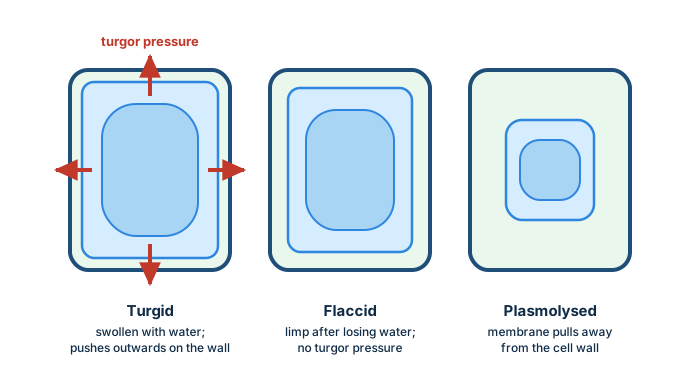
Flaccid (centre): the cell has lost water and no longer presses on the wall 3.
Related
- Turgid - The firm state before water loss.
- Turgor Pressure - The pressure that flaccid cells have lost.
- Plasmolysed - The next stage after further water loss.
- Osmosis - The water movement that causes it.
- Water Potential - Why water leaves.
- Small Vacuole - The shrinking water store.
- Biology - Cambridge IGCSE life-science area.
Footnotes
-
Cambridge IGCSE Biology 0610 syllabus for examination in 2026, 2027 and 2028 - The terms turgid, turgor pressure, plasmolysis and flaccid (3.2.8), and plants supported by water pressure pressing outwards on the cell wall (3.2.6). ↩ ↩2
-
OpenStax Biology 2e - Passive Transport - Turgor pressure in plant cells, tonicity, plasmolysis and wilting. ↩
-
Diagram drawn for this bundle, comparing turgid, flaccid and plasmolysed plant cells. ↩