Partially Permeable Membrane
A partially permeable membrane is a thin barrier with tiny pores. Small particles pass through, but larger particles cannot, so it sorts particles mainly by size 1. It is also called a semipermeable membrane.
Water molecules are small enough to diffuse through it by osmosis, from higher to lower water potential 1. Dissolved solutes such as starch and proteins stay behind, so only water crosses during osmosis 2.
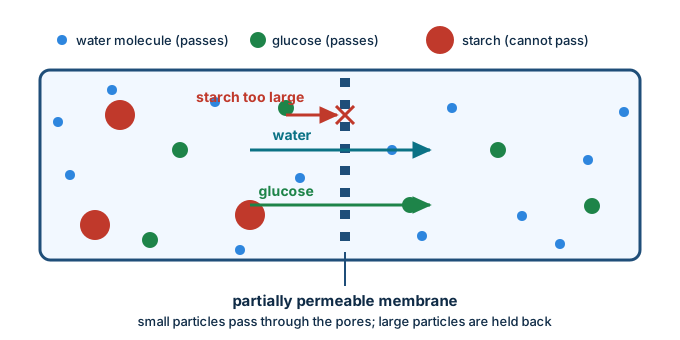
Small particles pass through the pores; large particles are held back 3.
Examples
- The cell membrane is partially permeable. Protein carriers in it also move specific ions and molecules by active transport 1.
- Visking® (dialysis) tubing is a manufactured partially permeable membrane. It separates starch and glucose from the water around it: glucose escapes and gives a positive Benedict’s test, while starch stays inside and turns iodine blue-black 1.
Related
- Cell Membrane - The partially permeable membrane of every cell.
- Water Potential - The gradient that drives water through the membrane.
- Osmosis - Water movement through this membrane down a water-potential gradient.
- Diffusion (Biology) - Net particle movement down a concentration gradient.
- Active Transport - Movement through membrane proteins against the gradient.
- Biology - Cambridge IGCSE life-science area.
Footnotes
-
Cambridge IGCSE Biology 0610 syllabus for examination in 2026, 2027 and 2028 - Water diffusing through partially permeable membranes by osmosis (3.2.2), investigating osmosis using dialysis tubing (3.2.4), the osmosis definition (3.2.7), and the apparatus list naming Visking or dialysis tubing. ↩ ↩2 ↩3 ↩4
-
OpenStax Biology 2e - Passive Transport - Selectively permeable membranes, osmosis as water movement along its concentration gradient, and retention of solutes. ↩
-
Diagram drawn for this bundle: small water and glucose particles cross the pores while large starch particles are held back. ↩